
He also offered India's experiences of participative political institutions, local governance, media and civil society with Africa.

'It is unrealistic to expect that security dilemmas and strategic distrust to disappear or even diminish any time soon,' says Rup Narayan Das.

The announcement of the formation of the BRICS bank will have as much an impact about how the non-G7 countries manage their economies and their foreign reserves, as it does on the intellectual discourse. The development priorities and agenda which was hitherto set by western experts responding mostly to western priorities and notions will now have to compete with an intellectual tradition that is and can be very different, says Mohan Guruswamy.

The BRICS summit offers Modi an excellent platform to reach out to world leaders and conduct diplomacy on the very ticklish issue of reform of the world governance structure, and to exchange notes with his peers on international, regional and bilateral issues on the margins of the meeting, says Rup Narayan Das.

Trump's new rules for how countries should treat him have led to the current breakdown in India-US relations, explains Ambassador T P Sreenivasan.
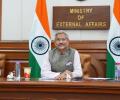
The BRICS stressed on resolution of conflicts in a declaration issued after a virtual meeting of foreign ministers of the member nations of the grouping. The meeting was attended by External Affairs Minister S Jaishankar and his Chinese counterpart Wang Yi.

The PM said there was a need to tackle the problem of terrorism in an organised manner.

Srikanth Kondapalli on what to expect from the seventh BRICS summit meeting to be held in Russia in July.

'There's no pro-China tilt in BRICS.' 'All these countries want to be close to China, but they are all good friends of India also.'

The agenda is to give a concrete shape to a Development Bank and pitch for reforms of the UN Security Council.

Prime Minister Narendra Modi said he looks forward to useful conversations with his fellow leaders from China, South Africa, Brazil and Russia on addressing pressing international and regional challenges that stand in the way of their goals.

Prime Minister Manmohan Singh on Thursday left Durban for home, ending a four-day visit during which he attended BRICS (Brazil, Russia, India, China and South Africa) Summit that decided to establish a development bank to finance infrastructure projects in emerging economies.

With its political colour dominated by less than democratic trends, BRICS currently leaves some of us wondering -- where in this grouping is there an assurance that human freedom will be respected unconditionally? It would be nice to see the new members of BRICS drawn from the ranks of countries wedded to preserving and guarding human freedom, observes Shyam G Menon.

'Happily,' says Ambassador B S Prakash, 'BRICS displayed new-found energy and built something real, a bank. Between needless nihilism and as yet unjustified euphoria, there are many stations for the BRICS train and we can watch its progress with renewed interest.'

Emerging nations have discussed delinking the quotas from the governance reforms to facilitate its passage.
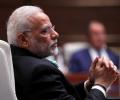
Modi said a separate rating agency would help the economies of the member countries as well as other developing nations.

Condemning strongly the terrorist attack in Paris, India on Sunday made a case for united global effort to combat the menace of terrorism.

Prime Minister Narendra Modi has left from Delhi for Brazil to attend the five-nation Brazil, Russia, India, China and South Africa (BRICS) summit slated to be held for two days, starting Monday. Here is his statement ahead of the meet.

Extending its support to Saarc Bank, Sri Lanka on Thursday said the proposed financial institution will help in alleviating poverty in the South Asian region.

'To consider BRICS anything more than a temporary club with some common interests would be folly. The goal should be to induce others (Japan, ASEAN, South Africa) to align with us -- a non-threatening, democratic nation, rather than with malevolent China or waning America. For us to consider aligning with either China or the US would be absurd. India is just too big to be a sidekick,' says Rajeev Srinivasan.

After visiting two Central Asian countries, Prime Minister Narendra Modi arrived in Ufa on Wednesday on a three-day trip during which he will attend the BRICS and Shanghai Cooperation Organisation summits.

The five-nation grouping BRICS on Tuesday resolved to combat terrorism in all its forms and manifestations, including the cross-border movement of terrorists, and vowed to step up joint efforts in building support for an India-backed global framework to effectively deal with the menace.

The 5-nation BRICS group on signed an agreement to create a $100 billion pool of foreign-exchange reserves to help each other.

Group still far from coordinating monetary/forex policy

The prime minister also said that country nurtures a mindset that loudly proclaims that terrorism is justified for political gains.

Noting that India has 'limitless possibilities and countless opportunities', Modi urged the BRICS business leaders to take advantage of them.

'The BRICS anthem has to necessarily be an anthem of Vedic times -- Walk together, Dream together, Achieve together.' 'And who knows it better than Modi?' says Tarun Vijay.

Modi said there were a slew of 'matching priorities' between the business council and that of his administration, including dismantling trade barriers, promoting skills development, establishing manufacturing supply chains and infrastructure development.
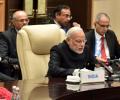
Modi in his address to the BRICS Leaders Meeting in Hangzhou said "terrorists in South Asia or any where for that matter do not own banks or weapons factories". "Clearly someone funds and arms them and BRICS must intensify joint efforts not just to fight terror but to coordinate actions to isolate those who are supporters and sponsors of terror," he said, without naming Pakistan which is a close ally of China.

Flush with liquidity, banks are eager to lend. And, therein lies the problem, warns Tamal Bandyopadhyay.
China's intended role for AIIB is not so different from the existing Western lenders like the World Bank.

India will place restrictions on foreign direct investment (FDI) in the national interest to ensure safeguards because of its location in a highly sensitive neighbourhood, Finance Minister Nirmala Sitharaman said during an interactive session at the Wharton Business School in the US on Tuesday. "I cannot blindly accept FDI simply because we need investment, unmindful of where it is coming from. "We want business, we want investment, but we also need some safeguards, because India is located in a neighbourhood that is very, very sensitive," Sitharaman said.

The impact of the sell-off on local equity markets was widespread among developing countries, but some were hurt more than others. Russia emerged as the worst performer among the four BRIC nations and saw the highest 72.5 per cent decline in local currency terms during last year.

'India has the potential to do a lot more to take advantage of the time today where we stand to gain, geopolitically and in terms of market attractiveness.'
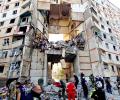
The US involvement in Ukraine and the Middle East is a distraction which has to end quickly so that the main business of China can be focussed on. China is America's only peer competitor, not Russia and not anybody else. Therefore it makes little sense to be diverted from the overall mission, explains Aakar Patel.

India, the bank's second biggest shareholder after China, is looking to borrow from the AIIB.

India is better positioned to face external shocks emanating from increasing geopolitical tensions, the aftermath of the COVID pandemic and the inevitability of climate change, Reserve Bank Deputy Governor Michael Debabrata Patra said on Monday. Relative to macroeconomic configurations in 2013 when India was described as one of the fragile five countries, he said, "India is better positioned currently, as its macroeconomic fundamentals have improved significantly, and external sector indicators point to the availability of enough cushions to manage external shocks." He was speaking at a conference on 'Growth And Development in the BRICS Economies' organised by the Delhi School of Economics (DSE) and the Indian Statistical Institute (ISI).

The government on Wednesday announced the appointment of veteran banker K V Kamath as chairperson of the newly set up Rs 20,000 crore development finance institution NaBFID to catalyse investment in the funds-starved infrastructure sector. Parliament had in March cleared the National Bank for Financing Infrastructure and Development (NaBFID) Bill 2021 to support the development of long-term non-recourse infrastructure financing in India, including the development of the bonds and derivatives markets necessary for infrastructure financing.

China does not have to give up what it took in 2020, it will never give up its claim to Arunachal Pradesh, Ladakh and other areas, and it has all the time now to plan its next surprise, points out Lieutenant General Prakash Katoch (retd).

Several factors seem to have corrected in India in the past six months, says the president of New Development Bank.
